Circuit breaker, RCD and voltage relay fitting
Circuit breaker and RCD fitting in Chișinău: we replace old screw-in fuses with breakers, match each circuit’s breaker to its cable and fit an RCD for the sockets and bathroom. We also fit voltage relays and whole-house stabilisers, so a voltage surge doesn’t burn out your appliances. The electrician gives you the price before starting.
The call-out and diagnosis are free if we do the job.
Leave a request
The data is processed in line with the privacy policy.
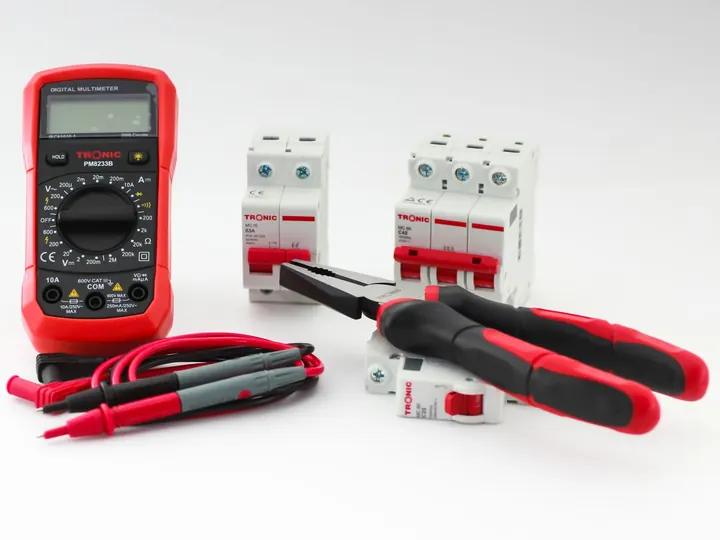
What we fit in the fuse box
You usually call us when a breaker trips often, when the box still has screw-in fuses, or after a voltage surge has burnt out an appliance.
- Circuit breakers in place of fuses, in the existing box or a new fuse box
- Usually a 10 A breaker for lighting and 16 A for sockets, matched to the cable size
- A 30 mA RCD for the sockets, the bathroom and the washing machine
- An RCBO, a breaker and RCD in one, for one circuit: water heater, hob or bathroom
- A single-phase voltage relay, set to cut the power on surges and drops
- A whole-house voltage stabiliser, fitted between the meter and the fuse box
- A new circuit for the hob, water heater or air conditioner, with its own breaker
The breaker before the meter is Premier Energy Distribution’s: if it has tripped or the whole building is without power, call them.
Breaker and RCD prices
The price is for each device fitted, and it goes up if the old box has no room left: then it needs new busbars or a bigger box. If we fit the devices, the call-out and diagnosis are free.
| Job | Price |
|---|---|
| Circuit breaker in the fuse box | from 80 lei |
| RCD or RCBO | from 150 lei |
| Voltage relay in the fuse box | from 150 lei |
| Whole-house voltage stabiliser connection | from 600 lei |
How the fitting goes
-
Finding why it trips
The electrician asks when the breaker trips, measures the load on the circuits and checks the size of the cable on each one.
-
Choosing the devices
He tells you which breaker goes on each circuit, where an RCD is needed and whether a relay or stabiliser is worth it. Then he gives you the price.
-
Fitting the devices
We switch off the power, mount the devices on the rail, tighten each wire in its terminal and run each circuit’s neutral through its RCD.
-
Testing the protection
We switch the circuits on one by one, press the RCD’s test button and set the relay’s voltage limits to suit your supply.
What do breakers, RCDs and relays protect?
A circuit breaker protects the cable: if more current flows than the cable can take, or there is a short circuit, the breaker trips before the wire heats up. That is why you never fit a bigger breaker just to stop it tripping: the cable stays the same and starts to heat up inside the wall. If a breaker trips often, the cause is in the circuit or in an appliance.
An RCD protects people: it cuts the power when some of the current leaks to earth, through the case of a faulty appliance or through someone’s body. Sockets and bathrooms get a 30 mA RCD. An RCBO does both jobs for one circuit, for example the water heater. Press the RCD’s test button once a month: it should trip.
A voltage relay protects appliances. In old blocks, when the neutral burns out on the riser, more than 300 volts can reach the sockets, and a fridge or a gas boiler burns out within seconds. The relay cuts the power until the voltage is back to normal. In houses at the end of a line, where the voltage sags in the evening, a stabiliser helps. An electrician in Chișinău tells you which you need after measuring the voltage.
Questions people ask
Can old screw-in fuses be replaced with breakers?
Yes, it is one of our most common jobs. If the old box has room, we mount the breakers on a rail inside it; if not, we fit a new box. First we check the cables: a breaker is chosen by the size of the wire, and in many old flats the wires are aluminium and thinner than they look.
Do I need an RCD if I have no earth?
Yes, then more than ever. Without an earth wire, the case of a faulty appliance stays live until someone touches it. A 30 mA RCD senses the leak through a person’s body and cuts the power in a fraction of a second. It doesn’t replace earthing, but in flats in old blocks it is the first protection we fit.
Which is better: an RCD or an RCBO?
It depends on how many circuits the box has. One RCD protects several circuits at once, but when it trips, they all go off. An RCBO protects a single circuit, so a leak in the water heater leaves the rest of the flat with power. In a small box we usually fit an RCD on the sockets and RCBOs on the bathroom and the water heater.
A voltage relay or a whole-house stabiliser?
A relay only cuts the power when the voltage goes out of range and switches it back on when it returns. A stabiliser raises or lowers the voltage, so appliances keep working when it drops. In a block of flats a relay is usually enough. A stabiliser is worth it where the voltage often falls below 200 volts, usually in houses at the end of a line, and it is sized to the power of all your appliances.
Breaker tripping often, or still on old fuses?
Call us or leave a request: the electrician comes, checks the fuse box and tells you which devices need replacing and what it costs.